On Panels
Panels is built from fragments, each of which was composed in a single day. The piece developed through what I think of as a Rhode Island School of Design style problem-setting model, where a “problem” is not something to be solved but a provocation to inhabit.
This way of working was something I encountered through the visual artist Francesca Woodman. Writing about Woodman’s student work at RISD, Rosalind Krauss describes how Woodman repeatedly returned to the same photographic situations, treating each shoot as a bounded exercise rather than a step toward a final image. Krauss writes that Woodman “internalized the problem, subjectivized it, rendered it as personal as possible.” What matters here is not the outcome of the task, but the way a constraint becomes absorbed into the maker’s own way of working.
That formulation resonated strongly with my compositional process in Panels. Each day I set myself a small problem or task, something like: what if a melody behaved like falling, or what if a tremolo felt like a quivering surface. The task was not to develop the idea or lead it somewhere, but to stay with it attentively. I wrote until that situation exhausted its pull, and then I stopped.
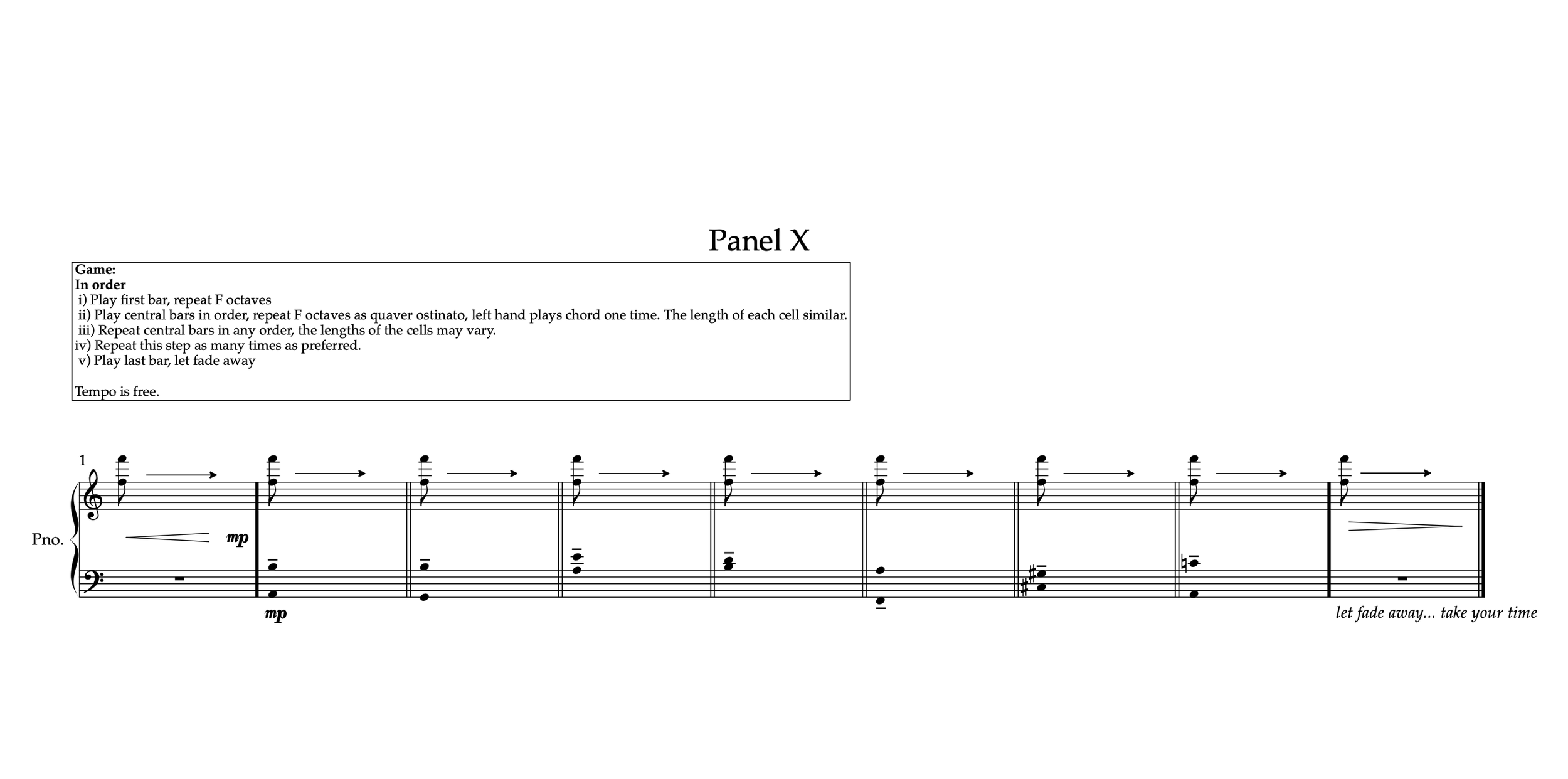
Panel X- Score Excerpt
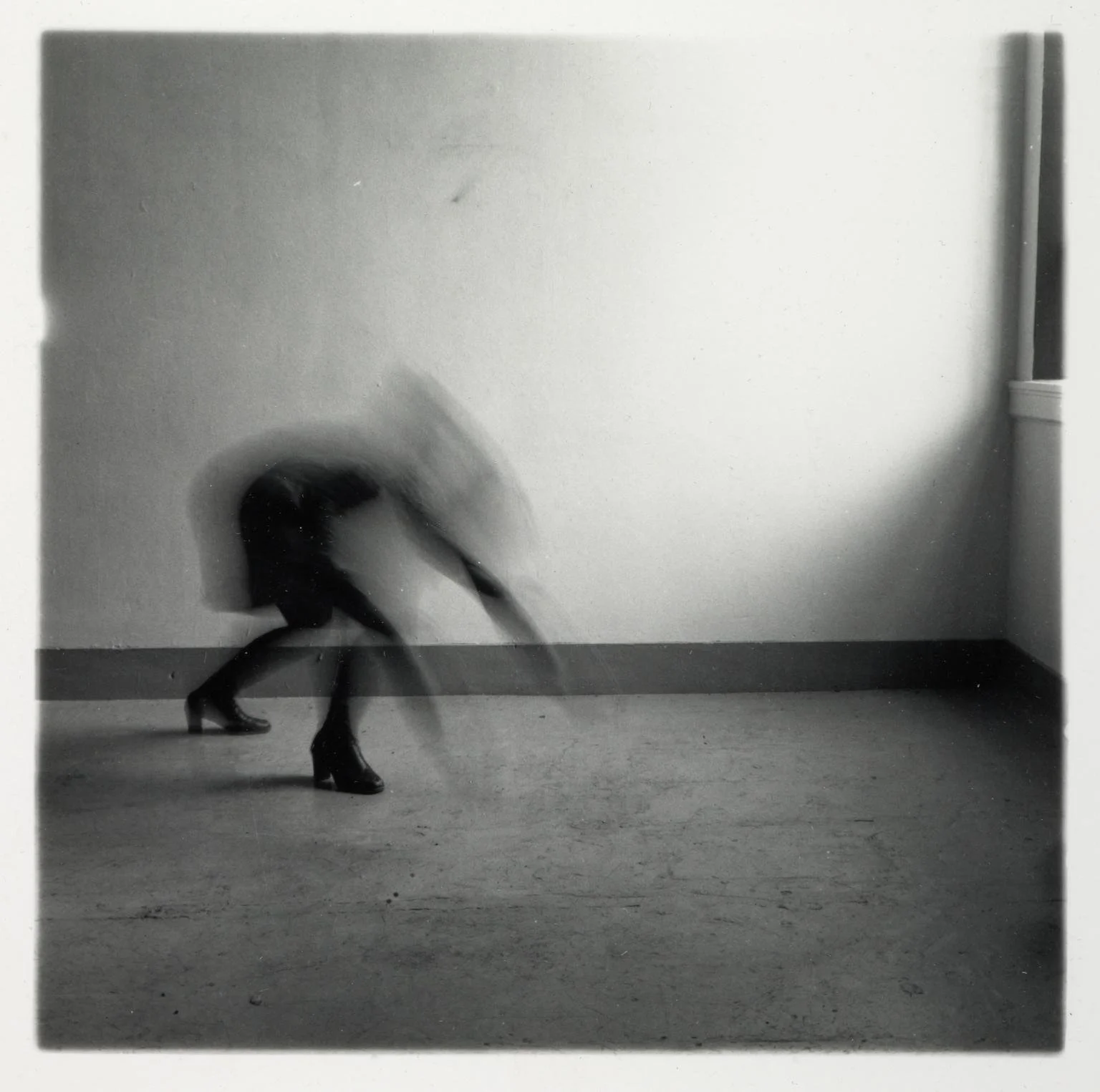
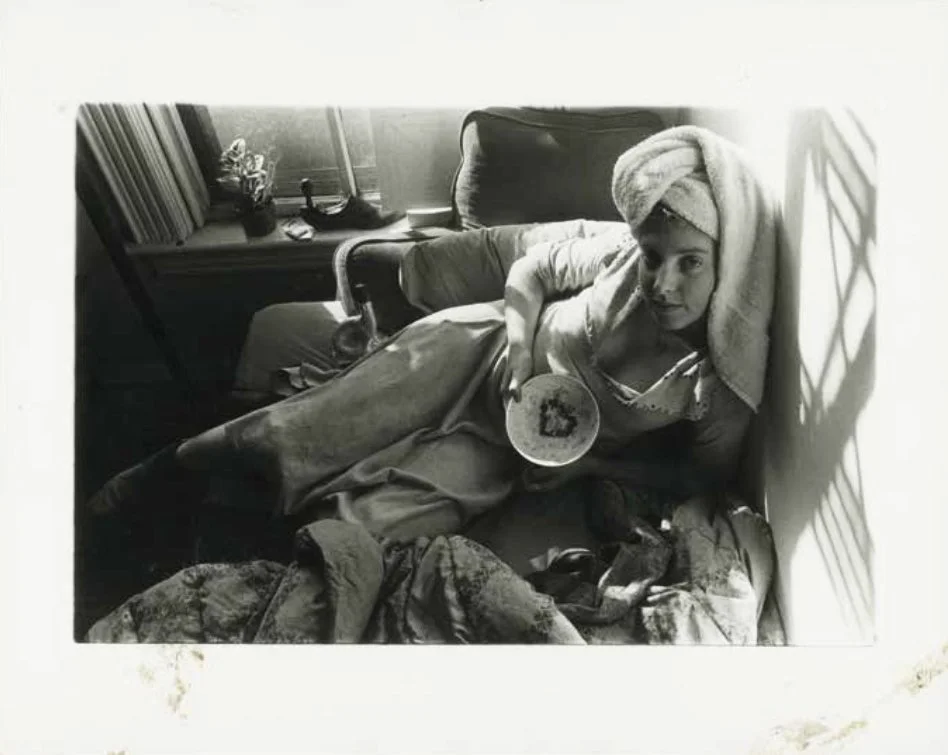
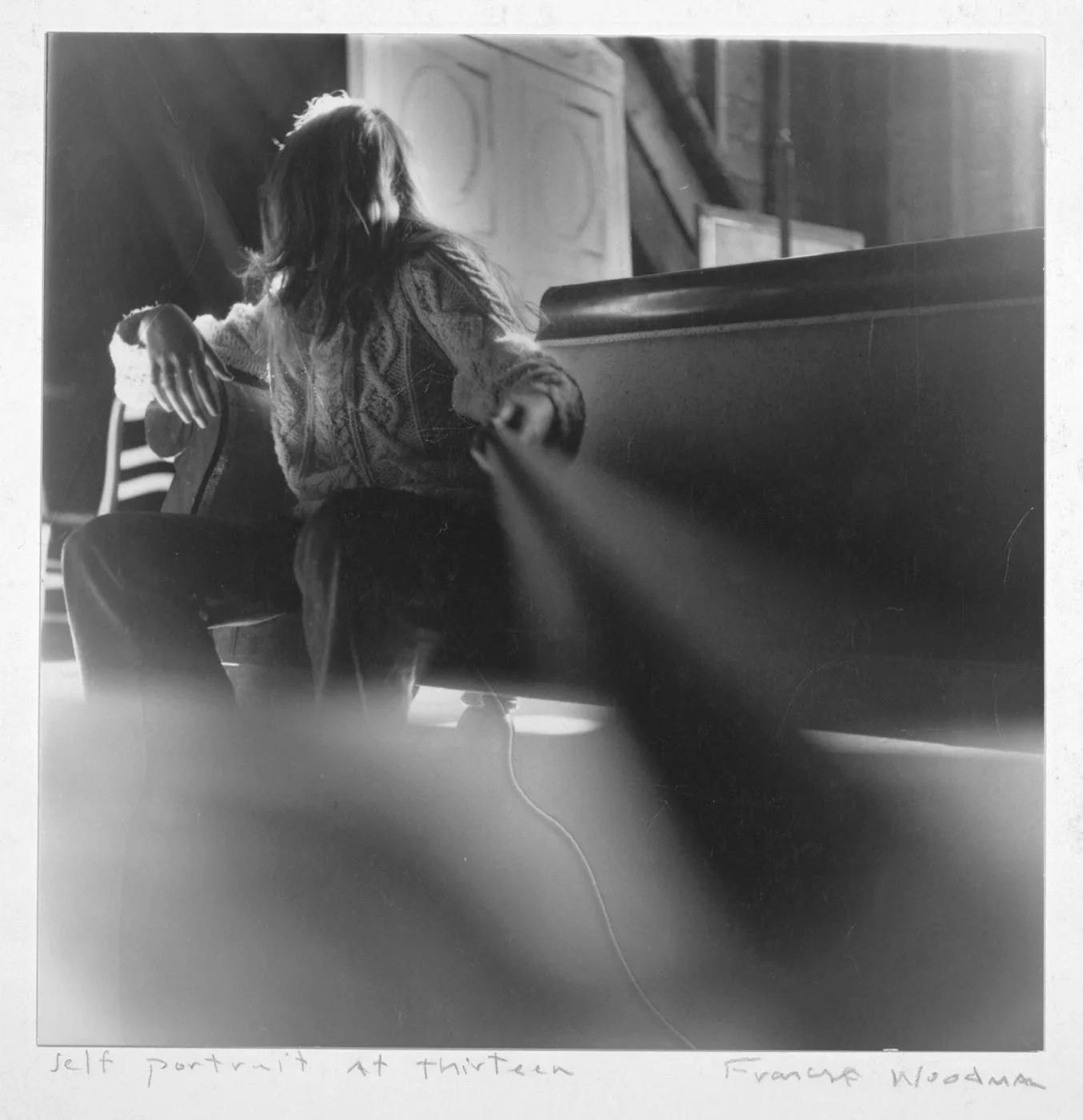
Francesca Woodman Photographs- personal favourites
Fragments, Games, and form
As a result, the fragments are not sketches. Each one functions as an autonomous process, with its own internal logic, but with no predetermined relationship to the others. Their sequencing is not composed by me, but chosen by the performer. Form therefore emerges in performance rather than being fixed in advance.
Alongside the notation, the score includes a series of conceptual instructions that I refer to as Games. These include indications such as “be suspended,” “let the fragment decay,” or “hover between line and texture.” They are not intended as interpretive flourishes. Instead, they introduce a layer of mental and perceptual labour, placing the performer in a condition of active navigation. In this sense, the performer mirrors the position I occupy while composing, a state of continuous adjustment rather than directed control.
Through this exchange, Panels becomes something like a shared environment, structured by tasks rather than trajectories. I generate the materials through in-time, embodied decision-making, and the performer completes the form through their own. The shape of the piece does not belong entirely to either of us. It emerges in the space between.
Although Panels is organised as a collection of fragments, the score itself is explicitly non-linear. The panels were composed one by one, each with a clear internal goal or task, but the ordering relationships between them are deliberately removed. The score does not prescribe a beginning, middle, or end, and there is no implied trajectory from one panel to the next.
At the level of the individual panel, the music is often goal-oriented. A repeated pitch is sustained until it no longer holds, a falling line continues until it loses coherence, a tremolo thins until it can no longer function as a surface. Each fragment is written toward a stopping condition. Once these panels are placed alongside one another, however, their linear connection is suspended. The goals do not accumulate, and no panel prepares the conditions for the next.
Without a fixed sequence, no continuity is secured in advance. Each panel appears as a local situation rather than as a step in a process. Form does not accumulate.
I think of the fragments as objects with different contours and shapes, with silence dressed around them. Each panel is surrounded by silence and allowed to emerge and return to it. The next panel is played only once the memory of the last has begun to fade, so silence becomes an active part of the work rather than an absence between events. Pedalling is often left to the performer, and the score explicitly encourages resonance and a degree of bleed between sonorities.
In Panels, performer labour is primarily mental rather than physically demanding. The Games and the modular layout place the pianist in a condition of active navigation, sifting through instructions and fragmentary materials and trying to find a path through the form. There is a deliberate break between how the work was made and how it is heard. The panels are written sequentially, but their order is structurally undone so that form is assembled in the moment through attention, pacing, and choice.
Case studies: selected panels
The following panels illustrate how Panels operates at the level of individual modules, showing the relationship between compositional task, the use of Games, and the constraints they establish in performance.
Panel II
· Process task: Write music bordering on melodic tension.
· Game: Lose the linearity.
· Constraint: Successive pitches are held without being shaped into a line, tension through balancing between movement and loose tones.
Panel X
· Process task: Construct a self-contained sequence around a repeated F-octave figure,.
· Game: Rules governing repetition, reordering, and when the final bar may fade, alongside the exact rhythm and tempo of ostinato.
· Constraint: Temporal unfolding is governed by performer process, I only give the materials.
Panel I
· Process task: Begin with a dense chord and break it into intervallic fragments treated as discrete sound objects.
· Game: Vary the order and spacing of these fragments.
· Constraint: The initial chord is hidden from view from the listener.
Panel XVI
· Process task: Present the same material twice in order to test repetition and memory.
· Game: Perform the second iteration as a “memory” of the first.
· Constraint: Repetition is structured to allow divergence rather than exact return.
Panel IX (Cantata on one chord)
· Process task: Reduce harmonic material to a single repeated sonority.
· Game: Silent internal counting, not intended to be perceptible to the listener.
· Constraint: Temporal precision is maintained internally while remaining unprojected, the listener is removed from the performers process.
Closing
Rather than proposing a fixed form, Panels offers a set of conditions through which form may arise provisionally and differently each time the work is played. Precision operates at the level of the fragment, while continuity at the level of the whole is deliberately withheld.
Related bibliography
Krauss, Rosalind E. Bachelors. Cambridge, MA: MIT Press, 1999.
(For Francesca Woodman’s RISD problem-setting practice and bounded exercises.)
Woodman, Francesca. Francesca Woodman. Edited by Chris Townsend. London: Phaidon, 2006.
(Primary source on Woodman’s student and early work.)
Saunders, James. “Modular Music.” Perspectives of New Music 46, no. 1 (2008): 95–122.
(On modular form, non-linear organisation, and performer navigation.)
Langer, Susanne K. Feeling and Form. London: Routledge & Kegan Paul, 1953.
(For form as a temporal, felt morphology rather than a pre-given structure.)
Spatz, Ben. What a Body Can Do: Technique as Knowledge, Practice as Research. London: Routledge, 2015.
(On embodied practice, sedimented technique, and labour in performance.)
Manning, Erin. Relationscapes: Movement, Art, Philosophy. Cambridge, MA: MIT Press, 2009.
(For in-time decision-making and emergence through practice.)
Graydon, Joseph. Panels (2025). Score for solo piano.
Images:
Francesca Woodman, Untitled, Providence, Rhode Island, c. 1976
Gelatin silver print
© The Estate of Francesca Woodman
Francesca Woodman, Self-Portrait, Providence, Rhode Island, c. 1976
Gelatin silver print
© The Estate of Francesca Woodman
Francesca Woodman, Untitled (House Series), Providence, Rhode Island, c. 1976
Gelatin silver print
© The Estate of Francesca Woodman